

Description
Remco Evenepoel
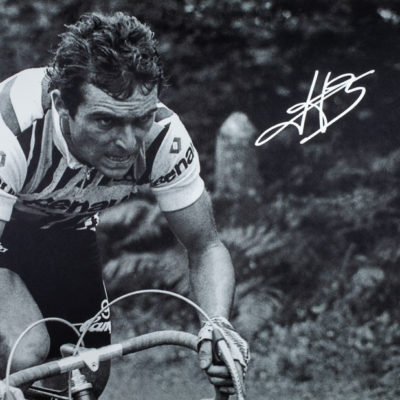
Remco Evenepoel’s rise from junior sensation to world champion, Grand Tour winner and double Olympic gold medallist has made him one of the leading figures in modern cycling. Born on January 25, 2000, and raised in Schepdaal, Belgium, he initially pursued football before turning to competitive cycling in 2017. His progress was extraordinary. Within eighteen months, he had emerged as the outstanding junior rider of his generation, combining powerful solo attacks with exceptional ability against the clock.
At the 2018 World Championships in Innsbruck, Evenepoel won both the junior individual time trial and junior road race. His road race victory was particularly memorable: after a crash interrupted his race, he chased back, attacked again and eventually rode alone to the finish. The performance demonstrated the determination and sustained attacking power that would become hallmarks of his professional career.
Evenepoel turned professional with Deceuninck–Quick-Step in 2019, aged nineteen, and immediately began winning against established professionals. During that first season, he claimed the overall title at the Belgium Tour, won the Clásica San Sebastián and became European elite men’s time trial champion. These results established him as a rider capable of succeeding in stage races, major one-day events and individual time trials, all within his debut professional season.
His early progress suffered a serious interruption in August 2020, when a crash at Il Lombardia left him with a fractured pelvis and a lengthy recovery. The accident became a significant turning point in his young career, requiring a gradual return to training and competition. He returned to winning in 2021, taking two stage race titles and a silver medal in the European road race championship.
The 2022 season brought his breakthrough at the highest level. In the spring, Evenepoel won Liège–Bastogne–Liège, claiming his first Monument. Later that year, he won the Clásica San Sebastián for a second time before securing overall victory at the Vuelta a España. At twenty-two, he became the first Belgian to win a Grand Tour since Johan De Muynck’s victory in the 1978 Giro d’Italia. His Vuelta triumph demonstrated that his time trialling strength and attacking instincts could be matched by the climbing ability and consistency required to win a three-week race.
Just two weeks after completing the Vuelta, Evenepoel won the elite men’s road race at the World Championships in Wollongong, Australia. He escaped with Alexey Lutsenko before dropping the Kazakh rider on the penultimate ascent of Mount Pleasant and continuing alone to the finish. His victory brought Belgium its first elite men’s road world title since Philippe Gilbert in 2012 and completed a remarkable season featuring a Monument, a Grand Tour and the world championship.
In 2023, Evenepoel successfully defended his Liège–Bastogne–Liège title and won the Clásica San Sebastián for a third time. He also added another dimension to his world championship record by winning his first elite individual time trial title. At the Vuelta a España, he recovered from losing his overall chances to win three stages and the mountains classification, demonstrating his ability to reshape a difficult race through aggressive riding.
His first Tour de France in 2024 produced another major milestone. Evenepoel won the stage seven individual time trial, finished third overall and secured the white jersey as the race’s best young rider. Soon afterwards, at the Paris Olympics, he won gold in the individual time trial and then delivered a solo victory in the road race. Despite a late puncture in the road race, he maintained his advantage to become the first man to win both Olympic road cycling events at the same Games.
Evenepoel continued to build an exceptional record in individual time trials, winning four consecutive elite world titles from 2023 through 2026. His fourth victory, in Montréal, followed successes in Stirling, Zürich and Kigali. He also began a new chapter with Red Bull–BORA–hansgrohe in 2026, having spent his first seven professional seasons with the Quick-Step organisation. From his junior world championship double to Grand Tour success and Olympic gold, his career has combined sustained power against the clock with the ability to turn decisive attacks into major victories.


Recent Comments