

Description
1980 Tour de France
The 67th Tour de France was held from 26 June to 20 July 1980, covering approximately 3,949 kilometers from its opening in Frankfurt, West Germany, to the traditional finish on the Champs-Élysées in Paris. The race comprised a prologue and 22 numbered stages, including split stages and two team time trials. Of the 130 riders who started, 85 reached Paris. Persistently cold, wet weather, the withdrawal of defending champion Bernard Hinault, and the remarkable dominance of the Dutch TI–Raleigh team shaped the Tour.
Hinault began the race as the clear favorite. The Frenchman had won the Tour in both 1978 and 1979 and arrived in Frankfurt after winning the 1980 Giro d’Italia. Victory in France would have completed the Giro–Tour double and given him a third consecutive Tour title. He immediately confirmed his form by winning the 7.6-kilometer opening prologue, finishing five seconds ahead of Gerrie Knetemann.
TI–Raleigh quickly established its strength. Jan Raas won the first road stage, and the team then captured the opening team time trial by 44 seconds over Hinault’s Renault squad. That result placed Knetemann in the yellow jersey. The following day, a long breakaway reached Metz almost ten minutes ahead of the peloton. Yvon Bertin took the race lead, while Rudy Pevenage—another member of the break—moved into yellow after the next stage. Henk Lubberding’s victory that day provided TI–Raleigh with another early success.
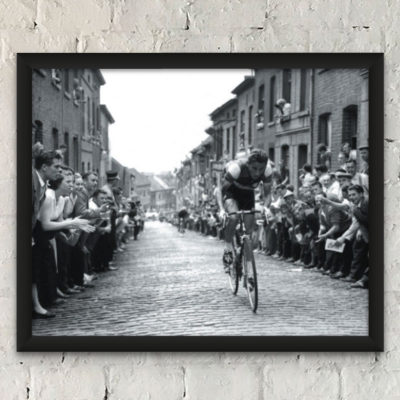
Hinault began reducing the deficit in the individual time trial at Spa, winning the stage by 1 minute 16 seconds over Joop Zoetemelk. Two days later, on the difficult road to Lille, the Tour crossed the cobbled roads of northern France in miserable weather. Despite his well-known dislike of racing over pavé, Hinault attacked decisively and won the stage, with only Hennie Kuiper receiving the same time. The victory brought Hinault to within 3 minutes 28 seconds of the yellow jersey, but the cold, rain and repeated strain of the opening week were taking their toll. He began suffering from tendinitis in his right knee.
While Hinault struggled with the injury, TI–Raleigh produced one of the most extraordinary sequences of stage victories in Tour history. The team won the second team time trial, after which Raas took another victory in the accompanying split stage. Bert Oosterbosch, Raas again, and Cees Priem then won the next three stages. Zoetemelk continued the run by winning the 51.8-kilometer individual time trial from Damazan to Laplume, beating Kuiper by 46 seconds and Hinault by 1 minute 39 seconds. Knetemann followed with another victory the next day. Counting the two portions of the split stage, TI–Raleigh had won seven consecutive stages.
Although Zoetemelk had beaten him in the time trial, Hinault reclaimed the yellow jersey from Pevenage and held a 21-second lead over the Dutchman. His injured knee, however, had become too painful to continue. On the morning of the first major Pyrenean stage, Hinault withdrew from the Tour while still leading the race. His departure ended his attempt to win a third successive title and transformed the contest for the general classification.
The race entered the Pyrenees with Zoetemelk as the new leader. The stage from Pau to Bagnères-de-Luchon crossed the Cols d’Aubisque, du Tourmalet, d’Aspin and de Peyresourde. French climber Raymond Martin attacked and rode to a commanding solo victory, finishing 3 minutes 13 seconds ahead of Sven-Åke Nilsson. Zoetemelk and Kuiper arrived together 3 minutes 27 seconds behind the winner. Zoetemelk retained yellow with a lead of 1 minute 10 seconds over Kuiper, while Martin climbed to third overall.
Zoetemelk’s position was tested again in the Alps. On the road to Pra-Loup, his teammate Johan van der Velde suffered a mechanical problem and swerved into his path. Zoetemelk crashed, cutting his arm and thigh, but remounted and finished with the principal contenders. Rather than losing time, he gained 16 seconds on Kuiper, increasing his overall advantage to 1 minute 34 seconds.
The following day brought a demanding 242-kilometer stage from Serre Chevalier to Morzine, crossing the Col du Galibier, Col de la Madeleine and Col de Joux Plane. Mariano Martínez won the stage, while Zoetemelk—still feeling the effects of his crash—was carefully protected by his TI–Raleigh teammates. He finished 31 seconds ahead of Kuiper, extending his lead to 3 minutes 5 seconds.
Zoetemelk effectively secured the Tour on the mountain stage to Prapoutel–Les Sept Laux. Ludo Loos escaped to win alone, but behind him Zoetemelk finished alongside leading climbers Lucien Van Impe and Joaquim Agostinho. Kuiper lost about two and a half more minutes, leaving Zoetemelk 5 minutes 22 seconds ahead of Raymond Martin and 5 minutes 39 seconds ahead of Kuiper. Zoetemelk then removed any remaining doubt by winning the final individual time trial at Saint-Étienne, beating Knetemann by 45 seconds and Kuiper by 1 minute 12 seconds.
The race concluded in Paris with Belgian rider Pol Verschuere winning the final stage on the Champs-Élysées. Zoetemelk secured the only Tour de France victory of his career in a total time of 109 hours, 19 minutes and 14 seconds. Kuiper finished second at 6 minutes 55 seconds, while Martin completed the podium at 7 minutes 56 seconds. Johan De Muynck placed fourth and Joaquim Agostinho fifth.
Zoetemelk’s victory came on his tenth appearance in the Tour. Before 1980, he had already finished second five times—in 1970, 1971, 1976, 1978 and 1979—making him one of the race’s most consistent contenders. At the age of 33, he became the second Dutch rider to win the Tour, following Jan Janssen’s victory in 1968. Although Hinault’s withdrawal inevitably became part of the story, Zoetemelk had already shown his strength by defeating Hinault in the long time trial. He then defended the yellow jersey through the Pyrenees, survived a crash in the Alps, and confirmed his superiority with another time-trial victory.
TI–Raleigh finished the Tour with an exceptional 11 stage victories, including both team time trials. Raas won three individual stages, Zoetemelk won two, and Lubberding, Oosterbosch, Priem and Knetemann each contributed one. Despite this remarkable total, Miko–Mercier–Vivagel won the team classification. Martin won the mountains classification, Pevenage captured the points classification, and Van der Velde was the highest-placed young rider. Sean Kelly also demonstrated his emerging sprinting ability by winning two stages during the final week.
The 1980 Tour remains memorable for its dramatic change of leadership, its severe weather and TI–Raleigh’s collective dominance. Above all, it was the race in which Joop Zoetemelk finally converted years of consistency and repeated near misses into a deserved Tour de France victory.


Recent Comments