


Description
1975 Tour de France
The 1975 Tour de France became a major turning point in the race’s history. Bernard Thévenet of Peugeot-BP-Michelin won his first Tour, ending Eddy Merckx’s extraordinary run of victories and becoming the first rider ever to defeat Merckx in a Tour de France that the Belgian had started. Thévenet finished 2 minutes 47 seconds ahead of Merckx, with Lucien Van Impe third at 5:01 and Joop Zoetemelk fourth at 6:42. Rik Van Linden won the points classification and green jersey, Van Impe won the mountains classification, and Francesco Moser won the newly established young rider classification and white jersey. The 1975 Tour was also the first in which the leader of the mountains competition wore the now-famous white jersey with red polka dots, and the first to finish on the Champs-Élysées in Paris.
Five-time Tour winner Merckx arrived in Charleroi attempting to accomplish something no rider had ever done: win the Tour de France six times. He was still very much the dominant figure in professional cycling and had already enjoyed a remarkable 1975 spring, winning Milan–San Remo, the Tour of Flanders, Liège–Bastogne–Liège and the Amstel Gold Race. Young Italian Francesco Moser provided an early surprise by beating Merckx by two seconds in the 6.25-kilometer opening prologue. Merckx soon asserted himself, however, taking control of the race and the yellow jersey after winning the Stage 6 individual time trial.
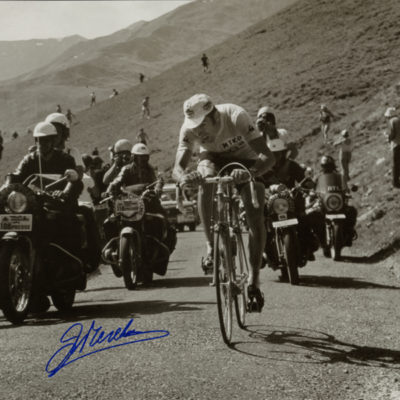
The race began to turn against Merckx in the mountains. On Stage 14 to the summit of the Puy de Dôme, Lucien Van Impe rode away to win while Thévenet reduced Merckx’s overall advantage. The stage is also remembered for one of the Tour’s most infamous incidents: close to the finish, a spectator struck Merckx as he climbed through the enormous roadside crowd. Merckx nevertheless finished the stage and retained the yellow jersey, but his lead over Thévenet had been reduced to just 58 seconds.
The decisive confrontation came two days later on Stage 15 from Nice to Pra-Loup. Merckx attacked on the descent of the Col d’Allos and reached the final climb ahead of his principal rivals, seemingly on his way to strengthening his grip on the race. Instead, the seemingly invincible Belgian suddenly began to struggle on the ascent to Pra-Loup. Thévenet came from behind, caught and passed Merckx, then overtook Felice Gimondi near the finish to win the stage. Merckx finished fifth, 1 minute 56 seconds behind Thévenet. The result completely reversed the race: Thévenet took the yellow jersey and now led Merckx by 58 seconds. It would prove to be the final day of Merckx’s career in the Tour de France yellow jersey.
Thévenet made his victory still more emphatic the following day, July 14, on the short but brutal 107-kilometer Alpine stage from Barcelonnette to Serre-Chevalier. Merckx attacked in an attempt to regain the race lead, but Thévenet ultimately took command on the Col d’Izoard. He crossed the famous summit alone and continued to the finish for a second consecutive stage victory, beating Merckx and the other leading contenders by 2 minutes 22 seconds. His advantage over Merckx in the general classification grew to 3:20, firmly establishing Thévenet as the man to beat.
Merckx refused to concede and kept attacking through the remaining Alpine stages despite further physical problems, including injuries from a crash. He managed to reduce Thévenet’s advantage slightly before Paris, but the Frenchman remained in control. After 3,999 kilometers of racing, Thévenet reached the finish with a winning margin of 2:47 over Merckx. Van Impe completed the podium at 5:01, followed by Zoetemelk, Vicente López Carril, Felice Gimondi and Moser.
The Tour ended on July 20 with another moment of cycling history. For the first time, the final stage finished on the Champs-Élysées, replacing the traditional Paris finish at the Vélodrome de Vincennes. Belgian sprinter Walter Godefroot won that inaugural Champs-Élysées finish, beginning a tradition that would become one of the defining images of the modern Tour de France. Thévenet stood in Paris as Tour champion for the first time, while Merckx finished second in what proved to be his final Tour de France.
****************************
This is a one-of-a-kind item; please review photos carefully to determine condition.



Recent Comments