

Description
1949 Tour de France
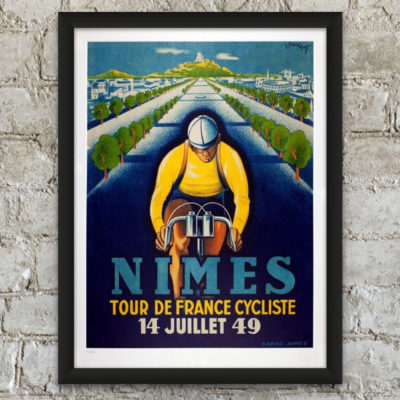
The 1949 Tour de France was the 36th edition of the race and one of the defining contests of cycling’s postwar era. Held from June 30 through July 24, it covered 4,808 kilometers in 21 stages, beginning and ending in Paris. The route traveled counterclockwise around France and crossed into Belgium, Spain, Italy, and Switzerland. Of the 120 riders who started, only 55 finished in Paris.
The race was organized around national and regional teams rather than the commercial trade teams familiar today. That system placed Italy’s two greatest champions—and fiercest rivals—Fausto Coppi and defending Tour winner Gino Bartali on the same squad. Coppi arrived after winning the Giro d’Italia, while Bartali had dominated the 1948 Tour. Italian team manager Alfredo Binda faced the difficult task of persuading both men to work together while promising that neither would receive preferential treatment.
The opening stages produced a succession of unexpected leaders. Marcel Dussault won the first stage into Reims, after which Belgian Roger Lambrecht won Stage 2 into Brussels and took the yellow jersey. Another Belgian, Norbert Callens, won the following day’s stage from Brussels to Boulogne-sur-Mer and moved into the race lead. Jacques Marinelli of the Île-de-France regional team then took over the yellow jersey after Stage 4 and began building a substantial advantage while Coppi and Bartali remained well down the general classification.
Coppi’s Tour nearly ended during Stage 5 from Rouen to Saint-Malo. He had joined Marinelli and several other riders in a break that established a lead of approximately six minutes when a spectator caused a crash. Marinelli continued, but Coppi’s bicycle was badly damaged. After a long delay, Coppi resumed on his own machine and began chasing with assistance from Bartali, but he eventually weakened and lost more than 18 minutes. Frustrated with the team’s support and believing Binda had favored Bartali, Coppi threatened to leave the race. Binda convinced him to continue.
Coppi began his recovery in the first individual time trial, a 92-kilometer test from Les Sables-d’Olonne to La Rochelle on Stage 7. He beat Ferdinand Kübler by 1 minute 32 seconds and Bartali by 4 minutes 31 seconds. Marinelli remained in yellow, but Coppi had provided the first clear demonstration of his extraordinary form. Even after the victory, however, Coppi remained approximately 28 minutes behind the race leader.
The general classification changed dramatically on Stage 10 from San Sebastián to Pau. Fiorenzo Magni and fellow Italian Serafino Biagioni joined Raymond Impanis and Édouard Fachleitner in a long-range break that gained approximately 20 minutes on the principal contenders. Magni won the stage and took the yellow jersey, placing another Italian at the head of the race while Coppi and Bartali still faced large deficits.
Stage 11 from Pau to Luchon introduced the major Pyrenean climbs of the Aubisque, Tourmalet, Aspin and Peyresourde. Coppi escaped with former Tour winner Jean Robic and Lucien Lazaridès, but a puncture slowed the Italian. Robic won the stage, Lazaridès finished with him, and Coppi arrived 57 seconds later. Despite missing the stage victory, Coppi cut his deficit nearly in half and moved to ninth overall, 14 minutes 46 seconds behind Magni. Bartali stood eighth, 13 minutes 4 seconds behind the yellow jersey.
Magni retained the lead as the Tour crossed southern France toward the Alps. The intervening stages offered opportunities to the sprinters and breakaway riders, including Rik Van Steenbergen, who won Stage 12 from Luchon to Toulouse, and Désiré Keteleer, winner of Stage 15 into Cannes. By the eve of the Alps, Magni still led, but the race’s most difficult mountains strongly favored Coppi and Bartali.
The first decisive Alpine stage came on July 18, Bartali’s 35th birthday. Stage 16 covered 275 kilometers from Cannes to Briançon and crossed the Col d’Allos, Col de Vars and Col d’Izoard. Coppi and Bartali rode away from the field and established themselves as the two strongest climbers in the race. When Bartali punctured on the Izoard, Coppi waited for his teammate and rival. They resumed together and reached Briançon more than five minutes ahead of Jean Robic. Bartali took the stage victory and the yellow jersey, while Coppi moved into second place, only 1 minute 22 seconds behind.
The following day’s 257-kilometer stage from Briançon to Aosta proved decisive. The route crossed the Montgenèvre, Mont Cenis, Col de l’Iseran and Petit-Saint-Bernard. Coppi and Bartali again separated themselves from the field, but Bartali suffered a puncture and later fell. Coppi initially waited, but with approximately 40 kilometers remaining, team manager Alfredo Binda instructed him to continue alone. Coppi rode to Aosta by himself, winning the stage by 4 minutes 55 seconds over Bartali and by more than ten minutes over the first chasing group. He took the yellow jersey with a 3-minute 57-second advantage over Bartali.
The remaining mountain stages did not alter the leading positions, but Coppi still faced one final major test: the enormous 137-kilometer individual time trial from Colmar to Nancy on the penultimate day. Coppi delivered a commanding performance, winning in 3 hours 38 minutes 50 seconds. Bartali finished second but lost 7 minutes 2 seconds, while Jacques Marinelli conceded more than eleven minutes and Jean Robic more than thirteen. Coppi’s overall advantage increased to an unassailable 10 minutes 55 seconds.
Rik Van Steenbergen won the 340-kilometer final stage from Nancy to Paris, with Stan Ockers second. Coppi entered the Parc des Princes as the Tour de France champion, completing the race in 149 hours 40 minutes 49 seconds. Bartali finished second at 10 minutes 55 seconds, Marinelli third at 25 minutes 13 seconds, Robic fourth at 34 minutes 28 seconds and Belgium’s Marcel Dupont fifth at 38 minutes 59 seconds. Fiorenzo Magni placed sixth and Stan Ockers seventh.
Coppi also won the mountains classification with 81 points, ahead of Bartali with 68 and Robic with 63, while Italy captured the team classification. Belgian riders enjoyed an excellent Tour, winning five stages: Roger Lambrecht won Stage 2, Norbert Callens Stage 3, Rik Van Steenbergen Stages 12 and 21, and Désiré Keteleer Stage 15.
The victory was historic for several reasons. It came in Coppi’s first appearance in the Tour de France, completed a remarkable recovery from his early crash and enormous time deficit, and made him the first cyclist to win the Giro d’Italia and Tour de France in the same season. He would repeat the Giro–Tour double in 1952, but the 1949 triumph established the original standard for one of cycling’s most demanding and prestigious achievements.


Recent Comments